
- What is Notion?
- Using it 🟢
- Nordic languages: the best in this series 🔵
- Where your data sits 🔵
- The contract is Californian 🔵
- The AI: a strong no-training promise with a retention catch 🔵
- Certifications 🔵
- Pricing from the Nordics 🔵 🟢
- Who owns it 🔵
- Verdict
- Scores
- What is still unresolved
- Related reading on this site
- Sources
- Keeping this up to date
At the time of writing, NordicAITools has no affiliate relationship with Notion. If that changes, this disclosure changes with it, and this verdict stays exactly as written.
This is general information, not legal advice.
Evidence note: onboarding, the workspace, the AI chat and the language settings are 🟢, done in the product on 10th of November 2026. Hosting, ownership, contracts, subprocessors and pricing are 🔵 from Notion’s own documentation and Trust Center. Items resting on inference or third-party reporting are marked 🟡 in place.
Over the last two weeks we have reviewed a French company, a Spanish company and an Estonian-founded one. Between them they offer, in their interfaces, a grand total of three Nordic languages.
Notion is American. San Francisco, Californian law, about as American as software gets.
Its interface is available in Finnish, Swedish, Danish and Norwegian. So is its entire help centre.
That is four out of five, and it is the best Nordic language support of any tool we have covered. If you have been assuming that a European vendor will serve your language and an American one will not, this is the review that should change your mind. Where a company is registered tells you very little. You have to check each thing separately.
The data story is a different matter, and we will get to it.

What is Notion?
A workspace that merges documents, wikis, databases and project tracking into one place. The point of it is that those things connect: a project page links to its own task board, its meeting notes and its working documents, so nothing lives in a separate app that nobody opens.
Alongside the workspace there is Notion AI, which now includes an Agent that runs tasks in the background, AI Meeting Notes, and an Enterprise Search that reads across Notion, Slack, Google Drive and GitHub.
Notion claims over 100 million users, more than 50% of Y Combinator startups and 62% of the Fortune 100, with named case studies including OpenAI, Figma, Toyota and Vercel. Those are the company’s own figures and none are independently verifiable, though the user number is plausible given how widely the product turns up.
Notion Mail was shut down on 22 September 2026, worth knowing if you were considering it.
Using it 🟢
Onboarding asks what you are here for, work or personal or school, and which function you sit in, then builds you a starting workspace from that. In our case it created a project called “The next articles I need to write” with a timeline and a status field already attached, which is a more useful starting point than an empty page.
It offers a choice at that moment between a 30-day Business trial and staying on the free plan. The desktop client is advertised as 50% faster than the browser; the browser version worked fine without it.
The product itself is well made and the navigation is the best part. The left sidebar splits Teamspaces, HQ, Projects, Tasks, Meetings and Docs, from your own private pages, so there is a clear line between what the company sees and what is still a draft. Project pages carry rich text fields for a TL;DR and goals, date properties, and live relations to connected databases. Task boards default to Not Started, In Progress and Done, and editorial notes convert into trackable tasks without retyping them.
If your organisation is growing and you want it to feel grounded rather than scattered across six tools, this is the category of thing that does that, and Notion does it well.
The most common pattern worth knowing about: one shared home for notes, documents, a knowledge base and task tracking, where the value comes from those things being linked rather than from any one of them. For a publisher that means article ideas, briefs, drafts, publication status and review dates in one place, which is Notion’s own suggested use for an editorial calendar.
The AI did something we did not expect 🟢
Opening a chat with Notion AI, it reads the workspace you are in. Asked for article ideas, it scanned the project page, worked out from the contents that the focus was affiliate publishing, and returned structured pitch frameworks rather than generic suggestions: buyer guides, comparisons, budget roundups.
Then we gave it two live URLs, this site and its European sister site, and asked it to evaluate them. It spent roughly 25 seconds searching and reading the actual pages, and came back with two specific recommendations based on what was already published rather than on what a generic SEO tool would suggest. One was a Pipedrive versus HubSpot comparison for Nordic businesses focused on local language support and pricing. The other was AI invoice and expense automation for European SMEs, built around regional VAT compliance and invoicing standards.
Both are reasonable ideas. More to the point, they were derived from reading our existing coverage and finding the gaps, which is a genuinely different thing from a keyword tool.
When asked what its chat was for, the AI explained that the point is not conversation but turning ideas directly into database records, tasks and drafts without leaving the workspace. That is a fair description of what it actually did.
Nordic languages: the best in this series 🔵
| Interface | Help centre | Support | Notion Academy | Your own content | |
|---|---|---|---|---|---|
| Finnish | Yes | Yes | Not published | No | Yes |
| Swedish | Yes | Yes | Not published | No | Yes |
| Danish | Yes | Yes | Not published | No | Yes |
| Norwegian | Yes (Bokmål) | Yes | Not published | No | Yes |
| Icelandic | No | No | No | No | Yes |
Danish, Dutch, Finnish, Norwegian and Swedish were all added together in release 2.34 on 7 November 2023. The interface now runs in 22 languages, and the help centre is translated into the same set, with Swedish at /sv, Norwegian at /nb, Danish at /da and Finnish at /fi.
You change it under Settings and Members, then Preferences, then Language and Time, and the interface language is set independently of the language you write in. On mobile it follows your phone’s system language.
Why this matters more than a feature checkbox. Every other tool in this series leaves at least part of your team working in English. With Notion, a Finnish company can run its whole internal workspace in Finnish, including looking things up in the help centre when something breaks. For a team where not everyone is comfortable in English, that is the difference between a tool people use and a tool one person maintains.
Iceland is the gap, again. No Icelandic interface, no Icelandic help centre. Icelandic users work in English, though they can write all their content in Icelandic. This is now the fifth consecutive tool where Iceland is excluded, after Pipedrive, ElevenLabs, Brevo and Typeform. At some point that stops being a coincidence about individual products and becomes a fact about the market.
Norwegian is Bokmål. The help centre path is /nb, and Nynorsk is not offered. That is the fifth tool in a row with the same answer, after DeepL, Pipedrive, ElevenLabs and Typeform.
One honest note from the AI itself. Asked about its own language abilities, Notion AI listed strong capability across English, Finnish, Swedish, Danish, Norwegian and the major European languages, and then volunteered that less common pairs including Icelandic may need human review. A vendor’s AI flagging its own weak spot unprompted is unusual and worth crediting.
Support languages are not published anywhere we could find. The interface and help centre are translated; whether a Finnish support ticket gets a Finnish reply is unknown. Assume English.
Where your data sits 🔵
Notion runs on AWS. The default region for every workspace is US-West-2 in Oregon, with backups in US-East-2 in Ohio. That is where your pages live on Free, Plus and Business.
EU data residency exists, and the terms are better than the competition’s.
Launched in September 2025, it puts data at rest in AWS Frankfurt with backups in Ireland. Two things make it unusually good by the standards of this series.
It is free of charge on Enterprise. Notion’s own documentation says so plainly: “Data residency is available free of charge to customers on the Enterprise Plan.”
And existing workspaces can migrate. “If you’re on an Enterprise Plan, you can request to move existing workspace data to your selected data region.” The US copy is deleted 30 days after migration, and Enterprise admins can set Europe as the default region for new workspaces.
That second point is worth dwelling on because Typeform, reviewed yesterday, restricts EU hosting to new accounts only. If you grow into needing European hosting, Notion lets you move and Typeform does not. For a small company that starts free and scales, that difference decides which tool is still viable in three years.
But it is Enterprise only, which means a sales conversation and custom pricing. On Free, Plus and Business, your workspace is in Oregon.
And read what EU residency actually covers. Included: page content, uploaded files, the search index, third-party and bot messages and files stored in Notion, and backups. Not included: account information and usage data, anything processed by subprocessors including the LLM providers, Notion Calendar, beta services, and integrations.
Notion is direct about the limit: the feature “only changes the data at rest storage location.” Two practical traps follow. Copying a template from a workspace in another region can move data out, and so can synced blocks pointing at a workspace elsewhere.
Encryption is TLS 1.2 or higher in transit and AES-256 at rest, with keys rotated regularly, per-minute backups of page content, and backups held in a separate region inside the same compliance zone. Deleted pages and workspaces are restorable for 30 days then permanently removed, and AI embeddings are deleted within 60 days of deletion.
For Norway and Iceland, both EEA members, Frankfurt counts as inside the EEA, if you can get it.
The contract is Californian 🔵
This is the sharpest difference between Notion and the European tools we have reviewed, and it is easy to miss because the company has a substantial European presence.
Notion Labs, Ireland Limited has been the EMEA headquarters since 2021 with over 100 staff, and new offices opened in London, Paris and Munich in September 2025. That is real investment in Europe.
But the Dublin entity is listed as a support subprocessor, not as the contracting party. Your agreement is with Notion Labs, Inc. in San Francisco, and the published Master Subscription Agreement states it is “governed by the laws of the State of California” with “the sole venue for all disputes” being “San Francisco County, California, USA.”
Compare: Brevo puts Nordic customers under French law in Paris. Typeform puts them under Spanish law in Barcelona. Notion puts them under Californian law in San Francisco. If a dispute ever matters to you, that is the practical difference.
Two gaps worth flagging rather than asserting.
Earlier versions of Notion’s privacy policy stated that Notion Labs, Inc. had certified under the EU-US Data Privacy Framework, captured as recently as April 2026. The current policy text we read does not mention it, and a policy tracker reports that the section was removed in an August 2026 revision 🟡. We have not been able to confirm the current status, and you should check dataprivacyframework.gov yourself rather than rely on either version. If the certification has lapsed, transfers rest on the SCCs alone.
And no EU or UK GDPR representative or data protection officer is named in the privacy policy we read. For a controller established outside the EU that offers services to people inside it, a designated representative is normally expected under Article 27. We could not find one. That is an absence rather than a finding, and it is the sort of absence worth asking about.
The AI: a strong no-training promise with a retention catch 🔵
The models: Notion’s subprocessor list names Anthropic, OpenAI, Google and X.AI as model providers, plus Baseten and Fireworks for model hosting and Cerebras for inference, with Exa and Parallel Web Systems for AI web search.
The commitment is clear: “Customer data is never used to train AI models by Notion or its subprocessors,” and Notion states its contracts with AI subprocessors prohibit it.
The catch is in retention, and it depends on your plan. On Enterprise, zero data retention at the LLM provider is the default. On Free, Plus and Business, providers may hold your data for up to 30 days before deleting it.
So on the plans a Nordic small business actually buys, the text you put into Notion AI sits with an American model provider for up to a month. Not for training, but it is there. If that matters to you, it is an Enterprise-only solution, same as the hosting.
Credit where due: features that require data-retaining models are off by default and an admin has to turn them on. That is the right way round, and more than most vendors do.
Where the AI runs is not stated. Notion’s own data residency page lists LLM providers as processing outside your chosen data region, so assume AI processing leaves the EU even on an EU-resident Enterprise workspace 🟡. We could not find a documented way to switch Notion AI off entirely, though admins can control web search and credit spending.
Notion’s Trust Center does carry an EU AI Act compliance statement, classifying Notion AI as a limited-risk system. Of the tools in this series, Notion is the only one where we found such a statement at all, which for a company with no EU contracting entity is a slightly surprising place to find the best AI Act documentation.
One curiosity worth a line: DeepL appears on Notion’s subprocessor list for translation, with its location given as US. DeepL’s own privacy policy says translation is processed exclusively on its infrastructure inside the EEA. Those two statements are hard to reconcile, and the likely explanation is a US contracting entity or endpoint rather than US processing 🟡. If you use Notion’s translation features on personal data, it is worth asking both companies.
Certifications 🔵
SOC 2 Type II, SOC 3, ISO/IEC 27001, ISO 27017, ISO 27018, ISO 27701 for privacy management, BSI C5 which is the German cloud security standard, ISMAP for Japan, HIPAA with a BAA on Enterprise, UK Cyber Essentials, CAIQ and a WCAG accessibility report.
ISO 27701 and BSI C5 are the two that stand out. German public sector and regulated buyers often require C5 specifically, and holding it means Notion has been audited against a European standard rather than only American ones.
No ISO 42001, the AI management standard, which Typeform does hold.
Pricing from the Nordics 🔵 🟢
Euro prices observed, per member per month, with 20 to 25% off for annual billing:
Monthly price:
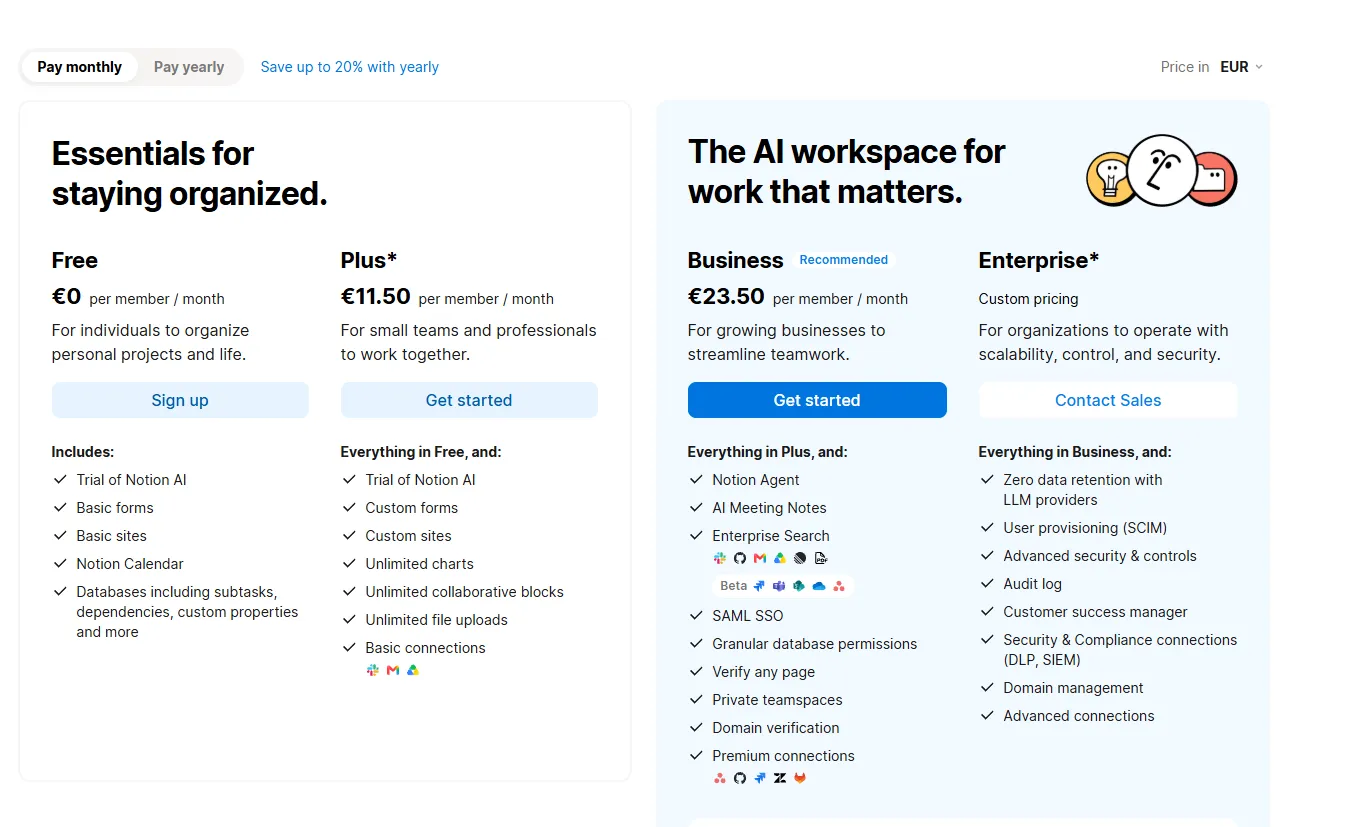
| Plan | Annual, per month | Monthly | What it adds |
|---|---|---|---|
| Free | €0 | €0 | Unlimited pages for a solo user, 5 MB file cap, 7-day history, 1 chart, 10 guests, AI trial |
| Plus | €9.50 | €11.50 | Unlimited blocks for teams, unlimited uploads, 30-day history, unlimited charts, database automations, 100 guests |
| Business | €19.50 | €23.50 | Notion Agent, AI Meeting Notes, Enterprise Search, 90-day history, SAML SSO, private teamspaces, 250 guests |
| Enterprise | Custom | Custom | Zero LLM retention, EU data residency, SCIM, audit log, HIPAA BAA, dedicated success manager |
A Custom Agents add-on costs €10 a month for 10,000 Notion AI credits.
The free tier has a catch that is easy to miss. For one person it is genuinely generous: unlimited pages and blocks, with only a 5 MB file upload cap and a 7-day page history to constrain you. But a workspace with two or more members is limited to a 1,000-block trial allowance. So the moment you invite a colleague, the free plan becomes a trial rather than a plan. If you are a solo operator, that distinction does not affect you at all.
Payment is by card, Apple Pay, Google Pay or Stripe Link, processed through Stripe and paid upfront. On iOS it goes through Apple’s in-app billing. On Android you cannot pay in the app at all. No SEPA direct debit or bank transfer is documented for self-service plans, and Enterprise is signed with sales so invoicing is presumably available there 🟡. No Nordic payment methods: no Swish, no Vipps, no MobilePay.
VAT: prices exclude tax. Notion charges VAT to consumers in Sweden, Finland and Denmark, and MVA in Norway. Businesses that add a valid VAT number under Settings then Billing are not charged VAT on later invoices, with Norway using the 123456789MVA format. Iceland is not on Notion’s tax list, so Notion does not charge Icelandic VAT and an Icelandic business would self-assess 🟡. Check with your accountant.
Refunds: full refund if you ask within three days of a monthly invoice or 30 days of an annual one.
Who owns it 🔵
Notion Labs, Inc., founded in San Francisco in 2013 by Ivan Zhao, still CEO, and Simon Last. Akshay Kothari is co-founder and COO. EMEA(Europe, the Middle East, and Africa) is run from Dublin by Mick Hodgins.
Private and venture-backed, with no controlling shareholder published and no IPO as of October 2026. Around 344 million dollars of primary funding, and notably no new primary capital since 2021. The Series C in October 2021 raised 275 million dollars at a 10 billion dollar valuation, co-led by Coatue and Sequoia. Earlier rounds brought in Index Ventures, which led the Series B, plus ICONIQ, First Round and Felicis. A secondary tender offer in December 2025 and January 2026 moved 270 million dollars of employee shares at an 11 billion dollar valuation, bringing in Singapore’s sovereign fund GIC.
So the investor base is predominantly American, with Index Ventures as the European presence and GIC as the Asian one. The company has not needed outside money for five years, which is a sign of health rather than a sovereignty fact.
Acquisitions: Automate.io in India in 2021, Cron in 2022 which became Notion Calendar, and Skiff, the encrypted mail and docs company, in 2024.
Roughly 80% of users are outside the United States, with tens of millions in EMEA.
The honest summary of the ownership picture: an American company with a real and growing European operation, which contracts with you from California. Being US-parented also means it falls under US law including the CLOUD Act regardless of where your data is stored, which is the thing EU hosting cannot solve.
Verdict
If language is your constraint, this is the pick, and nothing else comes close. Four Nordic interface languages with a translated help centre means a Finnish, Swedish, Danish or Norwegian team can work entirely in its own language. In this category, among the tools we have tested, that is unique.
If your data cannot sit in Oregon, you need Enterprise. Free, Plus and Business all store your workspace in the United States. The EU option is genuinely good when you get there, free and with migration allowed, but getting there means a custom contract.
If you use Notion AI on anything sensitive, note the 30-day retention at the model providers on every plan below Enterprise. Not for training, which Notion prohibits contractually, but present.
For Icelandic teams, you are working in English, as you have been with every tool in this series.
Where Notion beats the European alternatives: the Nordic languages, the free and migratable EU residency, BSI C5 and ISO 27701, an EU AI Act statement nobody else has, and data-retaining AI features that are off until you turn them on.
Where it does not: the contract is Californian, the default is Oregon, the Data Privacy Framework status is unclear, and no EU representative is named.
The honest summary: the most usable tool in this series for a Nordic team, and the most American one on paper. Those are both true, and which matters more depends entirely on what is in your workspace.
Scores
Sovereignty: 4/10 🔵
In favour: EU data residency in Frankfurt with Irish backups, free on Enterprise and open to existing workspaces, which is better than any competitor’s terms. A clear contractual prohibition on training. Data-retaining AI features off by default. An unusually strong certification set including ISO 27701 and BSI C5. An EU AI Act compliance statement. A real European operation with a Dublin EMEA headquarters and over 100 staff. Honest documentation about what EU residency does and does not cover.
Against: a US parent, a US contracting entity, and an agreement under Californian law with San Francisco courts. US default storage in Oregon on every plan a small business buys. EU residency gated behind Enterprise sales. EU residency excluding account data, usage data, AI processing, Calendar and integrations. LLM providers permitted to retain data for up to 30 days below Enterprise. Data Privacy Framework status unclear after an apparent removal from the privacy policy. No EU or UK representative named. Many US and Global subprocessors. CLOUD Act exposure that no hosting choice can fix.
Five, tying with Typeform, and the reasoning is worth stating because they get there differently. Typeform has the better corporate paperwork, an EU parent under Spanish law, but shuts EU hosting to anyone who did not start there. Notion has the worse paperwork, a Californian contract, but a European hosting path that is free, open and documented honestly. For a buyer who will never reach Enterprise, both end up storing your data in America.
Scale so far: ElevenLabs 4, Typeform 5, Notion 5, Pipedrive 6, Brevo 7. How these work is on our How We Test page.
Usability: 9/10 🟢
Based on onboarding, building out a workspace, testing the AI chat and checking the language settings.
What earns the top of our current range: it is the only tool in this series a Nordic team can run entirely in its own language, help centre included. The navigation genuinely helps rather than getting in the way, the split between shared teamspaces and private drafts is the right shape for how people actually work, and onboarding leaves you with a usable starting project rather than a blank page. The AI reading your own workspace and then your own live websites, and producing specific rather than generic suggestions, is the most impressive AI behaviour we have seen in this series.
What holds it at 9: the free plan drops to a 1,000-block allowance the moment a workspace has two or more members, which turns it from a plan into a trial without that being obvious up front. The AI features most people want sit on Business at €19.50 per seat per month, which adds up for a small team. And Icelandic is missing.
What is still unresolved
- Whether the April 2026 Master Subscription Agreement still uses Californian law, or offers an Irish entity and EU courts to European customers.
- Notion’s current Data Privacy Framework certification status, and whether an EU or UK GDPR representative has been appointed.
- DPA specifics: subprocessor notice period, objection rights, breach notification timing and audit terms.
- Where Notion AI processes data for EU-resident Enterprise workspaces, and whether AI can be switched off entirely.
- Whether support is actually available in Finnish, Swedish, Danish or Norwegian, given the interface and help centre are.
- Whether Enterprise contracts can be invoiced in SEK, NOK or DKK.
- How Notion handles Icelandic VAT.
- Why DeepL is listed as a US-located subprocessor when DeepL states EEA-only processing.
Related reading on this site
- Brevo for Nordic businesses: the EU hosting is real, the Nordic support is not
- Pipedrive for Nordic businesses: an honest review after signing up
- ElevenLabs for Nordic businesses: all five languages, but your audio goes to America
- AI tools with EU data residency: what Nordic businesses can actually use
- AI tools that integrate with the Nordic business stack
- AI meeting note-takers for Nordic businesses
- DeepL vs Google Translate vs ChatGPT/Claude for Nordic languages
- The EU AI Act for Nordic businesses: what actually changes, and when
- How We Test
Sources
- Data regions, EU residency on Enterprise free of charge, migration of existing workspaces, what residency covers and excludes, template and synced-block caveats: Help: Data residency
- Encryption, backups, certifications: Notion Security and Trust Center
- Subprocessor list, 26 entries with locations: Trust Center
- Worldwide transfers, SCCs, no EU representative found: Privacy policy, last updated 29 September 2025, and Help: Privacy practices
- AI model providers, the no-training commitment, plan-dependent LLM retention, data-retaining features off by default: Help: Notion AI security and privacy practices
- Californian law, San Francisco venue, nonrefundable fees: Master Subscription Agreement v.4, published copy
- Interface languages and how to change them: Help: Change your language
- Nordic languages added in release 2.34, 7 November 2023: Notion release notes
- Plan structure and USD prices: Notion pricing
- EUR prices, free-tier block limit for multi-member workspaces, Custom Agents add-on: observed in product, 13 October 2026 🟢
- Payment methods: Help: Payment methods
- VAT treatment including Norwegian MVA: Help: Sales tax
- Refund windows: Help: Refunds
- Notion Mail shutdown, 22 September 2026: Help: Notion Mail is going away
- EMEA expansion, Dublin headquarters, London, Paris and Munich offices: IT Europa, September 2025
- Founders, funding history, acquisitions, user numbers: Notion on Wikipedia, Sacra and Multiples.vc
- Data Privacy Framework section apparently removed in an August 2026 policy revision 🟡: third-party policy tracker, unverified
- Onboarding, workspace structure, AI chat behaviour, live site evaluation, language settings: hands-on, 13 October 2026 🟢
All checked 13 October 2026 unless a page carries its own date.
Keeping this up to date
Last reviewed: 10th of November 2026.