
- What is Typeform?
- Building a form took five minutes 🟢
- The free tier is a trial, not a plan 🟢
- Where your data actually sits 🔵
- The subprocessor list is long, and mostly American 🔵
- The AI commitment is the best we have seen 🔵
- Certifications 🔵
- Languages: your respondents get Nordic, your team does not 🔵
- Paying from the Nordics 🔵
- Contract terms worth knowing 🔵
- Who owns it 🔵
- Verdict
- Scores
- What is still unresolved
- Related reading on this site
- Sources
- Keeping this up to date
At the time of writing, NordicAITools has no affiliate relationship with Typeform. If that changes, this disclosure changes with it, and this verdict stays exactly as written.
This is general information, not legal advice.
Evidence note: signup, form building and the free tier are 🟢, done in the product on 13 October 2026. Hosting, ownership, contracts, subprocessors and pricing are 🔵 from Typeform’s own documentation. Items that rest on inference or third-party reporting are marked 🟡 in place.
Yesterday we reviewed Brevo: a French company that keeps every byte inside the European Union, and reserves the right to train its AI on your content.
Typeform is the mirror image. A Spanish company, incorporated in Barcelona, governed by Spanish law, that stores your form responses in Virginia. And which states plainly that it will not train any model on your data.
If you have been told that choosing a European vendor settles the data question, these two tools reviewed a day apart are the argument against that. Where a company is registered and where your data sleeps are separate facts, and you have to check both.
What is Typeform?

A form, survey and quiz builder, and the one most people recognise on sight because of the one-question-at-a-time style. Founded in Barcelona in 2012 by David Okuniev and Robert Muñoz.
Typeform now organises itself into three things. Ask is the forms product. Act, sold as Growth Flow, is lead capture with AI segmentation, follow-ups and data enrichment. Learn, sold as Research Flow, is AI-moderated research studies with panel recruitment. For most Nordic small businesses, only the first one matters.
Over 150,000 customers, more than 300 integrations including Salesforce, Zapier, Mailchimp, Google Analytics and Meta Pixel.
Two marketing claims to put in context: “trusted by 95% of the Fortune 500” and a data enrichment match rate of “up to 92%” for B2B profiles. Both are the vendor’s own figures, neither is independently verifiable, and “up to” is doing real work in the second one.
Building a form took five minutes 🟢
This is the part where Typeform earns its reputation.
Signing up is free and asks for no credit card. From there, a complete working form took about five minutes. The builder is genuinely simple: questions listed down the left, a live preview in the middle, settings on the right. Toggling a question to required, allowing multiple selections, randomising choice order, all one click.
The AI form creation works. You type what you want in plain language, and it produces a draft. Asked for a form about what people use AI for and what they would pay, it returned sensible multiple-choice and open text questions ready to edit. That is a real time-saver for anyone who has stared at an empty form builder wondering where to start.
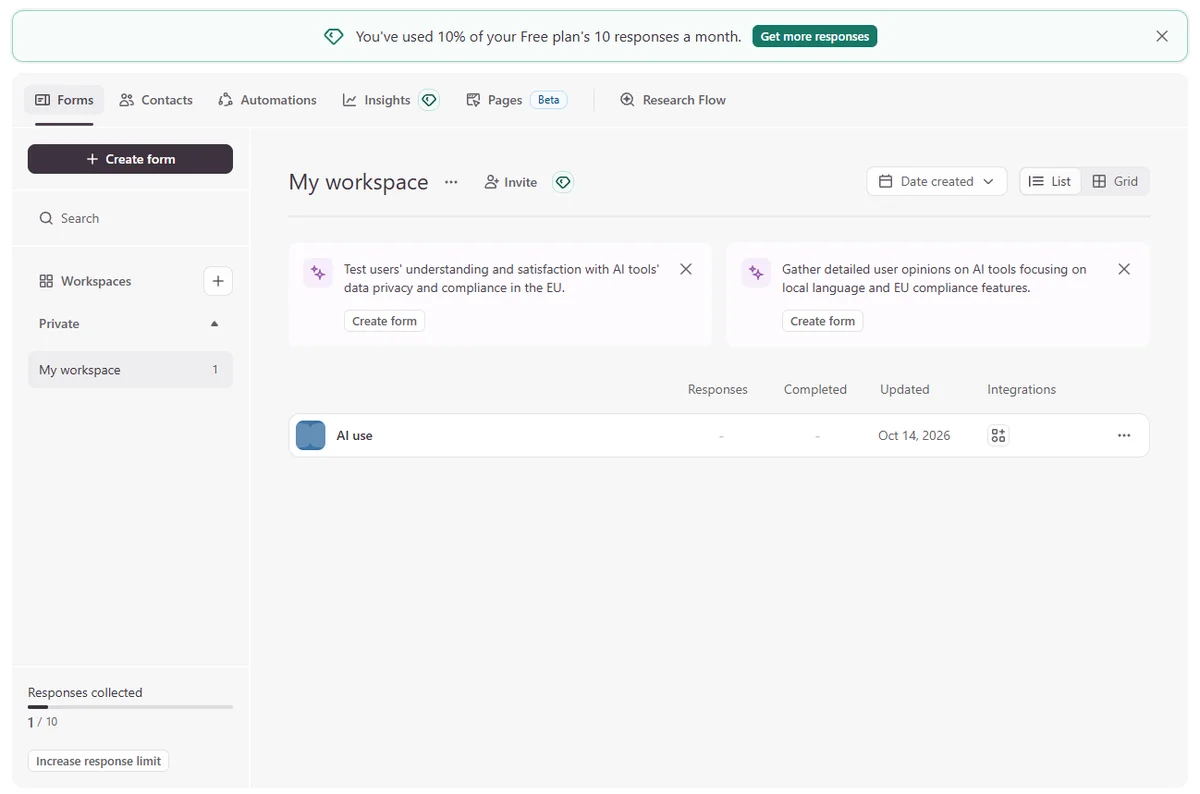
The dashboard gives you what you need at a glance: responses collected, completion rate, last updated.
Both the website and the app work well. No lag, nothing fighting you. Of the tools reviewed on this site, this is the most pleasant to actually use.
One small flourish worth mentioning. Abandon an upgrade at the checkout page and Typeform shows you an exit survey asking why you left, with options including “I was just exploring” and “I can’t afford Typeform.” A form company using its own product to handle churn is at least consistent.
The free tier is a trial, not a plan 🟢
Unlimited forms, over 3,000 templates, one user seat, and 10 responses a month.
That is the number that decides whether the free tier is useful to you. You can build whatever you like and send it to ten people. The eleventh is blocked.
For a genuinely small job, booking a workshop, polling a committee, collecting ten client testimonials, that is enough and it costs nothing, which is worth knowing because most people assume a free form builder means a usable one. For anything ongoing, it is a demo.
Compare Brevo’s free tier at 300 emails a day with full marketing automation and a CRM. Different categories, but it shows how much variation there is behind the word “free.”
Also worth knowing: inactive free accounts are deleted after 24 months without a login.
Where your data actually sits 🔵
Here is the finding.
Typeform’s own help documentation says it plainly: “All data is hosted on Amazon’s AWS service. Our main servers are located in Virginia, USA.”
That is the default on every self-service plan. Free, Basic, Plus, Business, Talent and Growth Flow. Your respondents’ answers are stored in the United States.
EU hosting exists, with two conditions that matter enormously.
It is available only on Enterprise and Growth Custom, the top two tiers with custom pricing. And per Typeform’s own help centre, it is for new accounts only: “new customers can do that with a Typeform Enterprise plan. This is not currently available for existing accounts.”
Read that twice, because it is the trap in this product. If you start on the free plan today, grow, and later decide your data needs to be in Europe, you cannot move. You would have to abandon the account and start again from nothing as a new Enterprise customer. Every tool reviewed on this site gates EU hosting behind a sales conversation. Typeform is the only one that also closes the door behind you.
What EU hosting actually covers. Typeform’s developer documentation calls it the “EU Responses Data Center” and says that “when dealing with responses data we need to store and process it on the servers physically located within the EU.” EU accounts use api.typeform.eu. Whether form definitions, account data and workspace data also stay in the EU is not stated anywhere we could find. Typeform does not name the AWS region either, though a third-party scan reports eu-west-1 in Ireland 🟡.
And it costs you features. On an EU-hosted account the payment question is unavailable, which means no Stripe or PayPal collection inside your forms, and some integrations drop out including monday.com and Salesforce Classic. The compliance configuration is the degraded one, which is a pattern we keep finding.
On transfers. Below Enterprise, responses and account data sit in the US under Standard Contractual Clauses, Module 3 for subprocessors and Module 4 for non-EEA customers, with the UK IDTA addendum. We found no EU-US Data Privacy Framework certification mentioned in the privacy policy, so the transfer mechanism appears to be SCCs alone. Both Pipedrive and Brevo hold DPF certification. If you are doing a transfer impact assessment for anything sensitive, that absence is relevant.
The privacy policy was last updated 14 March 2024 and does not name countries.
Encryption is TLS 1.2 and 1.3 in transit, AES-256 at rest, multi-availability-zone, with backups kept 15 days in a separate location.
For Norway and Iceland, both EEA members, EU hosting would count as inside the EEA. That only helps if you can get EU hosting, which on a self-service plan you cannot.
The subprocessor list is long, and mostly American 🔵
Typeform publishes its subprocessors properly, which deserves credit. The list is also a good illustration of why “EU company” is not the same as “EU data.”
Hosting and AI run through AWS, in the US unless you have EU hosting. OpenAI Ireland Ltd appears with its location given as US, for AI form building and results analysis. Google Cloud Platform, US, for AI in Research Flow. Pinecone, US, for the AI knowledge base. LiveKit, US, for voice and video in Research Flow. Mux, US, for video questions. Twilio Ireland, US, for SMS. FullContact, ZoomInfo and ScaleStack, all US, for response enrichment. Alloy, US, for integrations. Zendesk, US, for support. Snowflake, US, as data warehouse. Okta, US and EU, for SSO.
In the EU: Arize AI for AI monitoring, Forge Technology (Paragon) for integrations, Gmail for support email, Mailgun for platform emails, plus Gainsight, PowerPlay and Slack.
Support entities are Typeform DE GmbH in Germany, Typeform UK Ltd, and Typeform US LLC.
So even on an EU-hosted account, AI, video, enrichment and support still touch US processors. EU hosting means responses stored in the EU. It does not mean no American involvement.
The AI commitment is the best we have seen 🔵
This is where Typeform clearly beats the tools reviewed before it.
The models: Anthropic via Amazon Bedrock for Clarify with AI and qualitative Smart Insights, OpenAI for form creation and quantitative analysis, and Google Gemini.
The commitment, in Typeform’s own words: “None of our customers’ data is used to train any model regardless of the model powering the feature.” It further states that no data is stored with the LLM providers, and that Anthropic runs as “a private copy of the models.”
Set that against Brevo, whose Terms allow it to use customer content to train its own AI features with no opt-out we could find. On this specific question, Typeform’s position is unambiguous and better.
Typeform also holds ISO/IEC 42001, the AI management systems standard, and has signed the CSA AI Trustworthy Pledge. Very few tools in this space hold 42001. It is a real credential rather than a badge.
Two caveats. Some AI features are on by default, specifically Typeform AI and Quantitative Insights per the Service Terms. Smart Insights can be switched off in Admin settings; whether the others can is not documented. And where the AI runs is not stated. Given the subprocessor list puts OpenAI and Google Cloud AI in the US, assume US processing even on an EU-hosted account until Typeform says otherwise.
We found no EU AI Act statement, which is a gap for a company otherwise this organised about AI governance.
Certifications 🔵
The strongest set of any tool reviewed here: SOC 2 Type II, ISO/IEC 27001:2022, ISO 27017, ISO 27018, ISO/IEC 42001, CSA STAR Level 1, PCI DSS Merchant Level 3, and HIPAA with a BAA on Growth Custom. Annual third-party penetration tests, with reports in their Trust Center.
For comparison, Brevo holds ISO 27001:2022 and we found no SOC 2.
If your procurement process is a checklist, Typeform passes it comfortably. The checklist does not ask where the servers are.
Languages: your respondents get Nordic, your team does not 🔵
The split here is sharper than in any tool we have covered, and it falls in a useful direction.
The interface is English and Spanish. Two languages. The help centre adds French. Support is not published and is in practice English.
But the forms your respondents see support 28 languages, including Swedish, Norwegian, Danish and Finnish. That covers the buttons, hints, progress indicators and error messages, the system text a respondent actually reads. Multi-language forms with AI translation cover 27 languages with the same Nordic coverage, available from the Business plan up.
| Interface | Help centre | Form system texts | AI translation | Your own questions | |
|---|---|---|---|---|---|
| Finnish | No | No | Yes | Yes | Yes |
| Swedish | No | No | Yes | Yes | Yes |
| Norwegian | No | No | Yes (variant unstated) | Yes | Yes |
| Danish | No | No | Yes | Yes | Yes |
| Icelandic | No | No | No | No | Yes |
Why this matters more than it sounds. For a customer-facing survey, the respondent’s experience is the product. A Finnish customer filling in a Finnish form, with Finnish buttons and Finnish error messages, has no idea the tool behind it is administered in English. That is the right place for the language support to be, and Brevo does not offer it at all.
Your team still works in English. For a Finnish technical founder, fine. For a colleague who is not confident in English, a real cost.
Iceland is excluded again. No built-in form texts, no AI translation. You can write Icelandic questions, but the buttons and error messages around them stay in another language unless they can be overridden, which is not documented. That is now the third tool in a row where Iceland is the gap, after Pipedrive’s missing interface and ElevenLabs’ missing low-latency model.
Norwegian is listed without saying whether it is Bokmål or Nynorsk. That is the fourth time we have hit that ambiguity, after DeepL, Pipedrive and ElevenLabs.
Paying from the Nordics 🔵
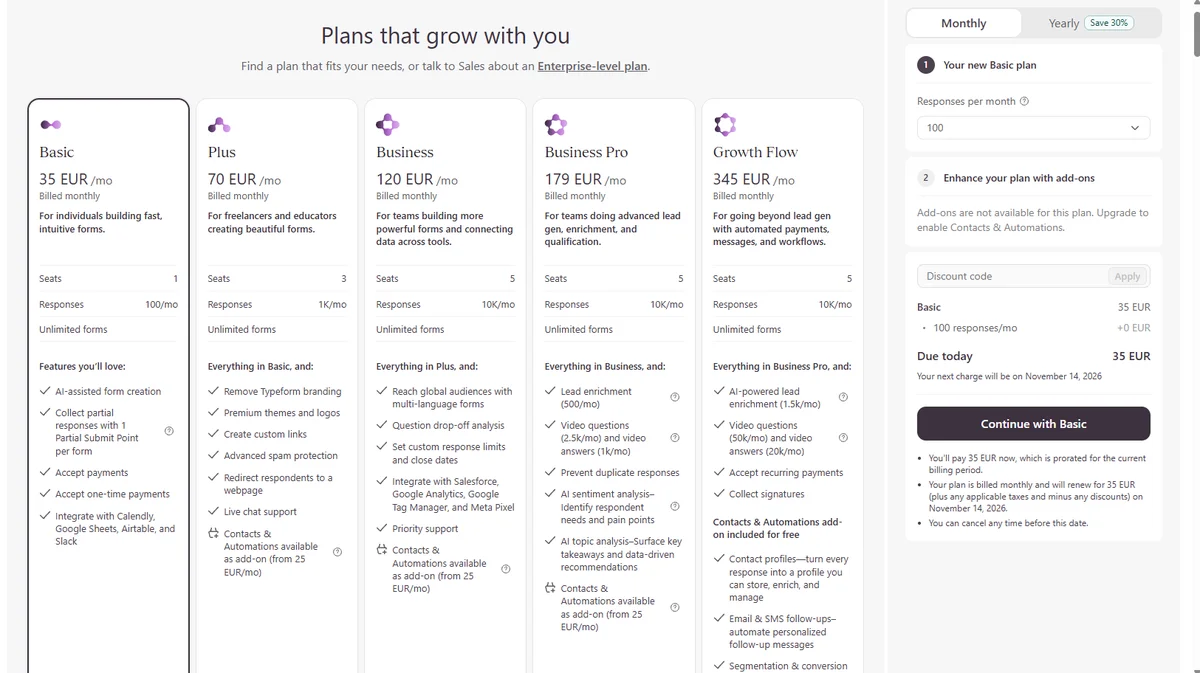
Monthly prices:
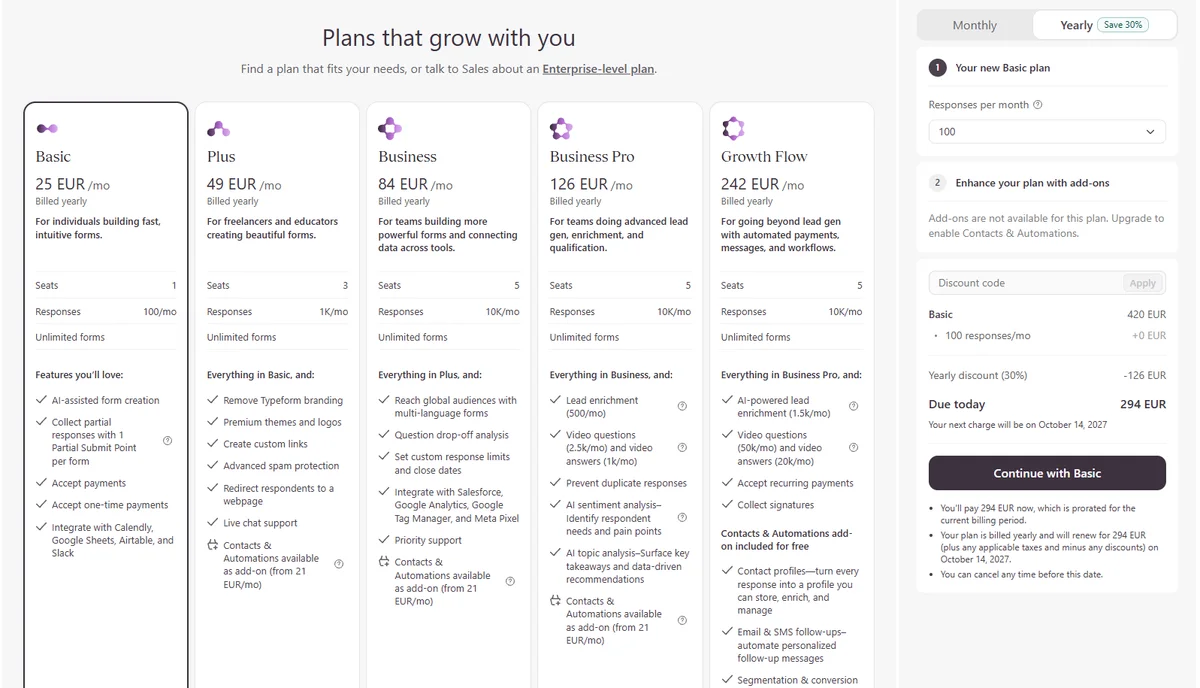
Yearly prices:
Typeform bills in US dollars, euros or sterling only. Its own help centre states the rule: “If you are outside any of these regions (USA, EU or UK), you will be billed in U.S. dollars.”
| Country | Local currency | Billed in |
|---|---|---|
| Finland | EUR | EUR, no conversion |
| Sweden | SEK | EUR, with bank FX cost 🟡 |
| Denmark | DKK | EUR, low FX risk given the peg 🟡 |
| Norway | NOK | USD likely, as Norway is not in the EU 🟡 |
| Iceland | ISK | USD likely, as Iceland is not in the EU 🟡 |
So a Norwegian or Icelandic business probably pays a Spanish company in American dollars. We have marked that inferred because Typeform’s rule says EU rather than EEA and we could not confirm which way the EEA countries fall. If you are in Oslo or Reykjavík, check the currency at checkout before committing, because the difference is a permanent conversion cost on every invoice.
The billing currency follows your billing address and you cannot change it yourself, only by contacting their billing team.
Prices. Typeform does not publish euro prices on its website. They appear only at checkout once you have an EU billing address, which means a European buyer cannot compare costs without starting a signup.
The euro figures seen at checkout, with roughly 30% off for annual billing:
| Plan | Monthly | Annual, per month | Responses a month | Users |
|---|---|---|---|---|
| Free | €0 | €0 | 10 | 1 |
| Basic | €35 | €25 | 100 | 1 |
| Plus | €70 | €49 | 1,000 | 3 |
| Business | €120 | €84 | 10,000 | 5 |
| Growth Flow | €345 | €242 | 10,000 plus enrichment | 5 |
| Enterprise / Growth Custom | Custom | Custom | Custom | 6+ |
A note on the figures. Typeform’s public USD pricing page lists Basic at 39 dollars, Plus at 79 and Business at 129, while a comparison table on the same page showed 29, 59 and 99. The euro checkout prices above are a third set. Pricing in this product is inconsistent across its own pages, so treat every number here as indicative and check your actual checkout. There is a Talent plan at 169 dollars for recruitment use that does not appear in the euro view.
Methods: Visa, Mastercard, American Express, Apple Pay, Google Pay, and PayPal only when you are billed in euros. No SEPA direct debit, no bank transfer, no prepaid cards. Manual invoices are Enterprise only. No Nordic payment methods: no Swish, no Vipps, no MobilePay.
VAT: prices exclude it. EU businesses in Sweden, Finland and Denmark add a VAT number before paying to get reverse charge, and it cannot be added to an invoice already paid. Norway and Iceland are not covered in Typeform’s tax documentation, so check your first invoice.
Fees are nonrefundable per the Payment Terms. Worth knowing before you pay annually.
One genuinely odd detail. The Stripe payment question inside forms supports SEK, NOK and DKK, so you can charge your own customers in their local currency. But the payment question is not available on EU-hosted accounts. So you can bill your customers in kroner, or keep your data in Europe, but not both.
Contract terms worth knowing 🔵
The DPA is with Typeform SL and built into the standard terms, covering typeform.com and videoask.com, so there is nothing to sign. A custom signed DPA is Enterprise or Growth Custom only.
New subprocessors are announced by email list subscription, with an objection window of 15 calendar days, half of Brevo’s 30. If you object, Typeform may terminate.
Audits: ISO and SOC 2 reports first, then a maximum of one audit per year at your own cost. Breach notification is “without undue delay” with no stated hours.
Deletion: your choice of deletion or return, and deleting the account deletes personal data. Typeform retains contract data for five years after the relationship ends.
Data protection contact is gdpr@typeform.com at the Barcelona address. As an EU entity, no Article 27 representative is required.
Jurisdiction: Nordic customers contract with TYPEFORM, S.L. in Barcelona under Spanish law, with disputes going to Barcelona courts. Consumer rights are preserved locally. US customers contract with Typeform US LLC in Delaware instead, a change made in September 2024.
Who owns it 🔵
Private and venture-backed, with no controlling owner published and no acquisition, buyout or IPO found through October 2026. That makes it genuinely independent in a way most tools we review are not.
Around 187 million dollars raised. The 135 million dollar Series C in March 2022, at a 935 million dollar post-money valuation, was led by Sofina, a Belgian family-controlled holding company. Earlier and returning investors include General Atlantic (US, which led the Series B in 2017 and holds a board seat), Index Ventures, Point Nine (Berlin), Connect Ventures (London), GP Bullhound (London with Stockholm roots, the only investor with any Nordic tie), plus Top Tier Capital and Teamworthy, both American.
So the cap table is a genuine European and American mix rather than American-dominated, which is a better story than Pipedrive, Penneo or ElevenLabs.
The shift worth noting is in leadership, not ownership. Long-serving CEO Joaquim Lechà was replaced in November 2024 by Jay Choi, an American executive previously Chief Product Officer at Qualtrics. The appointment announcement was datelined San Francisco. Co-founder David Okuniev remains on the board.
A Barcelona company with a San Francisco-datelined CEO announcement, a Delaware entity for US customers, and its main servers in Virginia. The Spanish registration is real and so is the Spanish jurisdiction. The centre of gravity has moved west.
Verdict
If you need a form that looks good and your respondents are Nordic, Typeform is the best-built tool in this review series. Five minutes to a working form, AI form creation that genuinely helps, and respondent-facing text in Finnish, Swedish, Norwegian and Danish. Nothing else we have tested makes the person filling in your form feel as at home.
If your form responses contain anything you would not want stored in the United States, do not use a self-service plan. The default is Virginia on every tier up to and including Growth Flow at 345 euros a month. That is not a footnote, it is the whole configuration.
And if there is any chance you will later need EU hosting, do not start on a free account. EU hosting is Enterprise and Growth Custom only, for new accounts only. Starting small and upgrading later is the one path that is closed to you. This is the single most consequential thing in this review and Typeform states it in a help article most people will never read.
For Norwegian and Icelandic businesses, check your billing currency before you commit. You may be paying a Spanish company in dollars.
Where Typeform is genuinely better than the alternatives: the commitment not to train any model on your data is the clearest we have found, ISO 42001 is a real AI governance credential, and the certification set is the strongest reviewed here.
The honest summary: an excellent product from a real European company that keeps your data in America, with a European escape hatch that only opens for customers who have not arrived yet.
Scores
Sovereignty: 5/10 🔵
In favour: an EU parent in Barcelona with Spanish law and Barcelona jurisdiction, no controlling foreign owner, a mixed European and American cap table, an unusually strong certification set including SOC 2 Type II and ISO 42001, a properly published subprocessor list, and the clearest no-training-on-customer-data commitment of any tool reviewed here.
Against: form responses stored in Virginia by default on every self-service plan. EU hosting restricted to the top two tiers and to new accounts only, so existing customers cannot migrate. EU hosting covers responses, with form and account data unaddressed. Feature loss when EU hosting is selected. No Data Privacy Framework certification found, leaving SCCs as the sole transfer mechanism. A long and mostly US subprocessor list that still applies on EU-hosted accounts. A 15-day subprocessor objection window. AI processing location unstated.
Five rather than four because the parent, jurisdiction, certifications and AI data commitment are all genuinely good, and better than ElevenLabs on every one of those counts. Five rather than six because the data is in America by default and the way out is shut to anyone who did not take it on day one.
Scale so far: ElevenLabs 4, Typeform 5, Pipedrive 6, Brevo 7. How these scores work is explained on our How We Test page.
Usability: 8/10 🟢
Based on signup and building a working form. We have not run a form to a real audience at volume.
What earns it: no credit card at signup, a form built in five minutes, AI form creation that produces something usable from a plain-language prompt, a clean three-panel editor, a dashboard that shows what matters, and both web and app working smoothly. This is the most pleasant product in the series to use.
What holds it at 8: the free tier at 10 responses a month is a trial rather than a plan, and the step to 100 responses costs 35 euros a month. There is no Nordic interface, so your team works in English. And Typeform’s own pricing pages disagree with each other, which is a poor first impression from a company this polished.
What is still unresolved
- Whether Norway and Iceland are billed in USD or EUR, and how VAT is handled for them.
- Whether EU hosting covers form and account data or only responses, which AWS region it uses, and whether existing accounts can ever migrate.
- Where AI features run for EU-hosted accounts, and whether all AI features can be switched off.
- Whether Typeform US LLC holds EU-US Data Privacy Framework certification.
- Whether built-in form texts can be manually overridden to support Icelandic.
- Whether Norwegian form text is Bokmål, Nynorsk or both.
- Whether Enterprise contracts can be invoiced in SEK, NOK or DKK.
Related reading on this site
- Brevo for Nordic Businesses: the EU hosting is real, the Nordic support is not — the mirror case to this one
- Best GDPR-compliant email marketing tools for Nordic businesses — the Nordic-built alternatives, no affiliate links
- AI tools with EU data residency: what Nordic businesses can actually use
- Pipedrive for Nordic businesses: an honest review after signing up
- ElevenLabs for Nordic businesses: all five languages, but your audio goes to America
- The EU AI Act for Nordic businesses: what actually changes, and when
- How We Test — our evidence tiers and what the scores mean
Sources
- US hosting in Virginia, AWS, encryption and backups: What happens to my data and Security at Typeform
- EU hosting restricted to Enterprise and to new accounts only: Enterprise plan
- EU Responses Data Center scope and API endpoints: Typeform developer docs
- Features unavailable on EU hosting: Integrations available on the EU Data Center
- Full subprocessor list with purposes and locations: What other companies do we share data with
- DPA, 15-day subprocessor objection window, audit limits, deletion and retention: Data Processing Agreement, last updated 20 July 2026, and Do I have to sign a DPA?
- Contracting entity, Spanish law and Barcelona courts: Service Terms and Conditions
- Transfers on Standard Contractual Clauses, no Data Privacy Framework certification found: Privacy policy, last updated 14 March 2024
- AI model providers, the no-training commitment, private model copies and default-on features: AI with Typeform FAQ, AI Services terms and AI info
- Certifications including SOC 2 Type II, ISO 27001:2022, ISO 27017, ISO 27018, ISO 42001, CSA STAR and PCI DSS: Security at Typeform
- Interface languages: How to change the language of your account
- Form system text languages (28): Form language
- Multi-language forms and AI translation (27): Create multi-language forms
- Support channels and hours: How to get help
- Billing currency and the outside-USA-EU-UK rule: What currency will I be billed in and Upgrade your plan
- Payment methods: How can you pay for a Typeform subscription and Apple or Google Pay
- VAT and reverse charge: Taxes
- Nonrefundable fees: Payment Terms and Conditions
- Stripe payment question currency support, including SEK, NOK and DKK: Stripe integration FAQs
- USD plan prices: Typeform pricing
- EUR plan prices: observed at checkout, 13 October 2026 🟢
- Founding, founders, investor list and funding history: Typeform on Wikipedia, General Atlantic on the Series B, TechCrunch on the Series C, Catalonia Trade and Investment on the Series C and Typeform’s own Series C post
- Jay Choi appointed CEO, November 2024, San Francisco dateline: PR Newswire
- US billing entity change, September 2024: Changes to contractual relationship and billing entity for US customers
- Billing currency discussion: Typeform community
- AWS eu-west-1 Ireland for EU hosting 🟡: meetergo sovereignty scan, April 2026, third party, unverified
- Signup, form building, free tier limits, editor and dashboard behaviour: hands-on, 13 October 2026 🟢
All checked 13 October 2026 unless a page carries its own date.
Keeping this up to date
Typeform’s pricing pages currently contradict each other, so prices here are indicative. The EU hosting restriction to new accounts is described as “not currently available for existing accounts,” which implies it may change, and if it does this review needs revisiting.
Last reviewed: 14 October 2026.
