
- The short version on AI Tools That Integrate With the Nordic Business Stack
- Why integration is the real gatekeeper in the Nordics
- How AI actually connects (the middle layer)
- The Nordic stack, tool by tool
- At a glance
- So what should you actually do?
- How this connects to your wider setup
- Common questions
- Keeping this up to date
The short version on AI Tools That Integrate With the Nordic Business Stack
A brilliant AI tool that cannot talk to your accounting system is close to useless for a Nordic business. Your company almost certainly runs on Fortnox, Visma, Procountor, Dinero or Tripletex, and the real question is not “is this AI tool clever,” it is “can it plug into what I already use.”
The honest map:
- If you use Fortnox or Visma: you are in luck. Both connect natively through Zapier to thousands of apps, and AI plugs in easily with almost no technical work.
- If you use Procountor or Tripletex: it is doable but more technical. You will likely use Make, a developer, or a connector service rather than a simple one-click setup.
- The bridge between AI and your accounting system is usually an automation tool (Zapier, Make, or the open-source n8n), not a direct AI-to-accounting link. That middle layer is where the magic actually happens.
This article is a plain map, not a deep technical manual. It tells you what connects easily, what takes more effort, and how AI fits in.
Why integration is the real gatekeeper in the Nordics
Nordic SMBs live inside their accounting software. Fortnox dominates in Sweden, Visma is pan-Nordic, Procountor is a Finnish staple, Dinero is common in Denmark, and Tripletex is widely used in Norway. These are not just bookkeeping tools; they are the financial backbone of the business.
So when a Nordic business evaluates an AI tool, the unspoken first test is: does it fit into this backbone, or is it one more disconnected app that creates manual work? An AI tool that forces copy-pasting into Fortnox is dead on arrival. One that quietly automates a step inside the existing flow is worth paying for.
That is why “integrates with the Nordic stack” matters more here than flashier features.
How AI actually connects (the middle layer)
Here is the part that clears up most of the confusion. AI tools rarely connect directly to your accounting software. Instead, a middle layer sits between them and does the plumbing:
- Zapier is the most popular no-code connector. You set up “when X happens in Fortnox, do Y,” with no coding. It connects to thousands of apps and now has AI features built in.
- Make (formerly Integromat) is a more visual, more flexible connector, often cheaper at scale and better for more complex flows. It handles some Nordic tools (like Tripletex) that Zapier does not.
- n8n is the open-source option. You can self-host it, which appeals to the privacy-conscious and to the Finnish developer community in particular, because your data stays on your own server.
Think of these as the universal adapters. The AI does the thinking, the accounting system holds the records, and Zapier, Make or n8n carries data between them.
The Nordic stack, tool by tool
Fortnox 🇸🇪 (Sweden): the easiest to automate
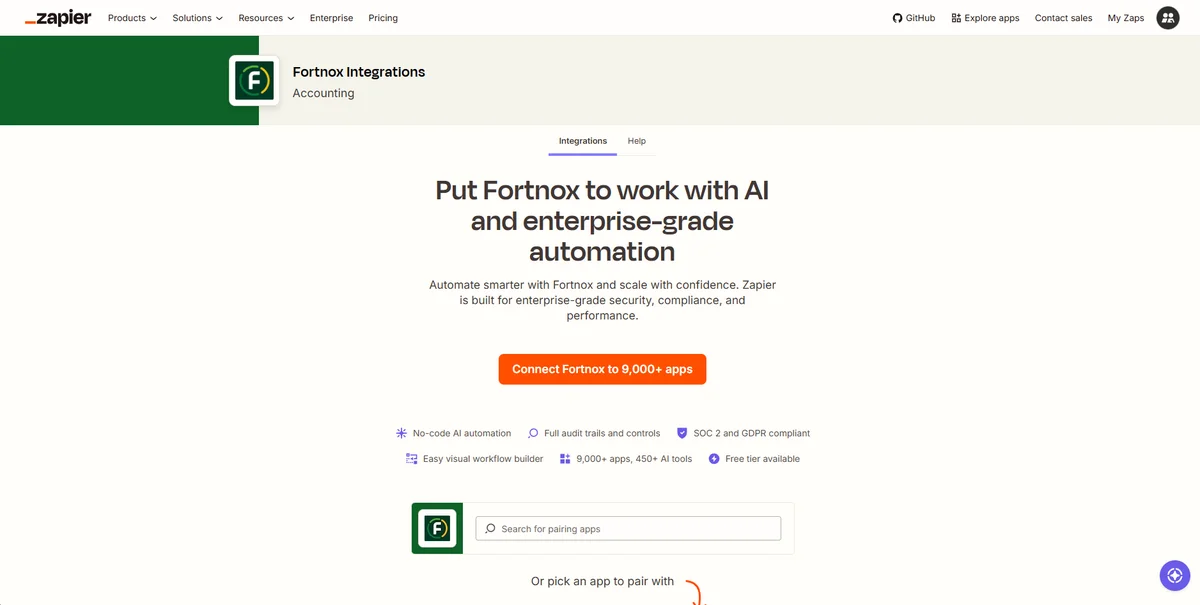
Fortnox has a native Zapier connector and links to thousands of apps, with ready-made triggers like “invoice paid” or “new customer created.” Even better for this topic, Zapier’s own AI features let you drop OpenAI or Anthropic models straight into a Fortnox workflow to extract, summarise or categorise data. If you are on Fortnox, connecting AI is genuinely easy and mostly no-code.
Integration ease: 🟢 Easy (native Zapier, AI-ready).
Visma eAccounting 🇪🇺 (pan-Nordic): also straightforward
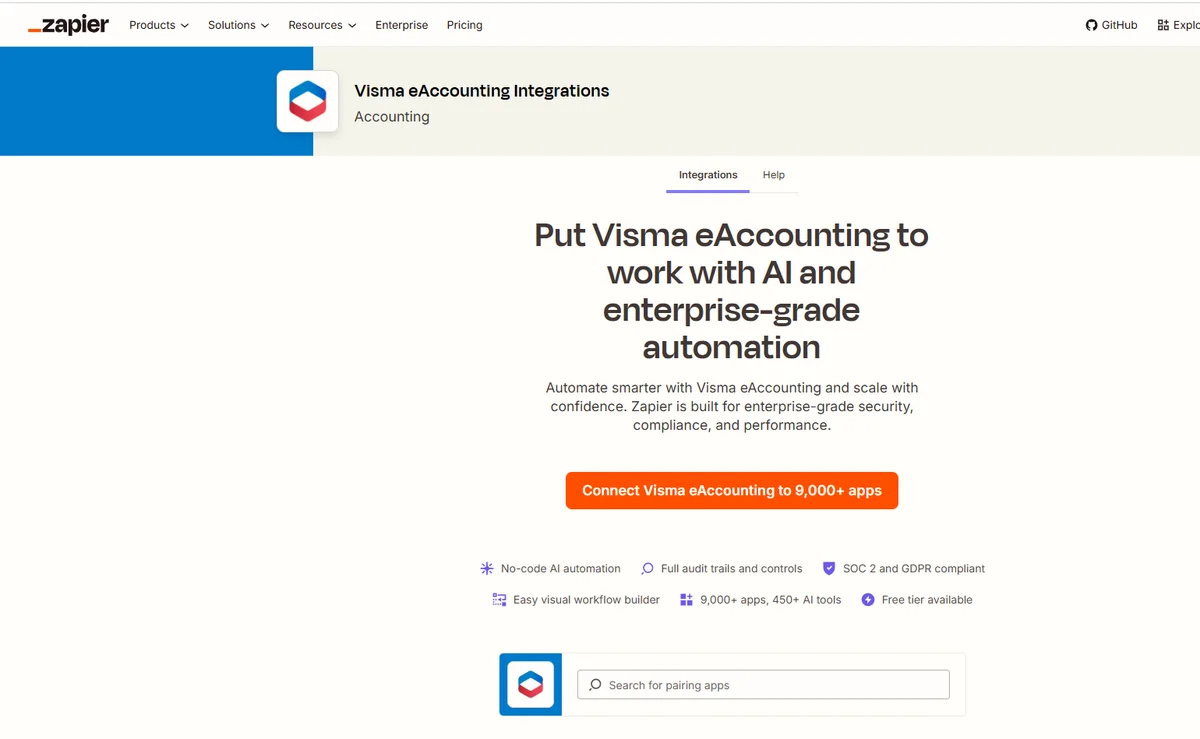
Visma eAccounting has a native Zapier connector too, linking to thousands of apps with triggers for new invoices, suppliers and customers. Like Fortnox, it slots into no-code AI automations without much fuss. Note that “Visma” is a large family of products (eAccounting, Netvisor and others), so the exact integration path depends on which Visma product you run.
Integration ease: 🟢 Easy for eAccounting (native Zapier); varies by Visma product.
Procountor 🇫🇮 (Finland): powerful, but more technical
Procountor is the Finnish workhorse, and it has a well-documented, modern REST API available across the Nordic countries. But it does not have a simple one-click Zapier app the way Fortnox does. In practice, connecting AI to Procountor means using Make, a connector service, or a developer to work with its API. It is very capable, just not plug-and-play for a non-technical user.
A note from our own use: we run Procountor in our own business, and the reality matches this. The software itself is solid and does real Finnish e-invoicing well, but automating it with outside tools is a step up in effort compared to the click-and-go Zapier experience of Fortnox. Expect to involve Make or someone technical.
Integration ease: 🟡 Doable via API/Make, not one-click.
Tripletex 🇳🇴 (Norway): use Make
Tripletex, the Norwegian cloud accounting and project platform, connects through Make (with an API and tokens), letting you automate invoice creation, expenses and payroll sync. So Norwegian businesses have a clear path, it just runs through Make rather than a simple Zapier app.
Integration ease: 🟡 Good via Make.
Dinero 🇩🇰 (Denmark): check the connector route
Dinero is popular with small Danish businesses. Connecting it to AI generally goes through connector services or its API rather than a simple native app, so treat it like Procountor: doable, but plan for the API/connector route rather than one-click.
Integration ease: 🟡 Via API/connectors; confirm current options.
The unified-connector option (for all of them)
Worth knowing: there are middleware services (such as Zwapgrid and Apideck) that specifically exist to connect Fortnox, Visma, Procountor, Dinero and Tripletex through a single integration. These are aimed more at software builders than at individual businesses, but if you are a Nordic SaaS or a more technical operation wanting to connect once and reach every Nordic accounting system, this is the category to look at.
At a glance
| Accounting system | Country | Easiest AI-connection route | Ease |
|---|---|---|---|
| Fortnox | Sweden 🇸🇪 | Native Zapier + built-in AI | 🟢 Easy |
| Visma eAccounting | Pan-Nordic 🇪🇺 | Native Zapier | 🟢 Easy |
| Procountor | Finland 🇫🇮 | API / Make / developer | 🟡 Technical |
| Tripletex | Norway 🇳🇴 | Make | 🟡 Moderate |
| Dinero | Denmark 🇩🇰 | API / connectors | 🟡 Technical |
Ease reflects how simply a non-technical user can connect AI automations. All are capable; some just need more setup. Verify current connector options before you commit, since these change.
So what should you actually do?
- On Fortnox or Visma eAccounting? Start with Zapier. You can build useful AI automations (categorising invoices, summarising data, syncing customers) with no code. This is the fastest win.
- On Procountor, Tripletex or Dinero? Plan to use Make, or budget a little developer time for the API. Very doable, just not a five-minute job. n8n is worth a look if you want to self-host for data-privacy reasons.
- Privacy-conscious or a Finnish dev shop? Look at n8n (open-source, self-hostable) so your financial data stays on your own infrastructure.
- Building software for the Nordic market? Look at unified connectors (Zwapgrid, Apideck) to reach every accounting system at once.
One honest caution: whenever you connect AI to your financial data through any of these, you are sending accounting data through a third-party tool. Check where that tool processes data and whether it fits your GDPR obligations, which matters as much here as the integration itself.
How this connects to your wider setup
Integration is one piece of the Nordic tooling puzzle. Where your data is processed matters just as much, which we cover in AI Tools with EU Data Residency.
Common questions
Can I connect ChatGPT or Claude directly to Fortnox? Not directly, but easily through a connector. Zapier links Fortnox to AI models with no code, so you can build AI-powered workflows without a developer.
Which Nordic accounting tool is easiest to automate with AI? Fortnox and Visma eAccounting, because both have native Zapier connectors. Procountor, Tripletex and Dinero are doable but need Make or API work.
Do I need to know how to code? For Fortnox and Visma, no. Zapier is no-code. For Procountor, Tripletex and Dinero, you will likely need Make or some technical help.
What is n8n and why does it come up? It is an open-source, self-hostable automation tool. It appeals to privacy-conscious users and the Finnish developer community because your data can stay on your own server rather than a third-party cloud.
Is it safe to connect AI to my accounting data? It can be, but you are routing financial data through a third-party tool, so check that tool’s data handling and GDPR posture first.
Keeping this up to date
Integrations and connectors change often, new native apps appear, others change terms. We verify against current documentation and date this. Last reviewed 8.7.2026. If a connector option has changed, tell us and we will check and correct it.
Published by NordicAITools Editorial. Integration details are verified from current vendor and connector documentation (🔵), with our own hands-on Procountor use noted where relevant (🟢), in line with our published methodology.
