
When your customer asks the AI instead of Google
- When your customer asks the AI instead of Google
- Why this matters now (and why it is different from SEO)
- What actually gets you cited by AI
- What we found measuring our own site
- The Nordic opportunity
- A practical starting plan
- How this connects to your wider strategy
- Common questions
- Sources
- Keeping this up to date
How to Show Up When People Ask ChatGPT:
A potential customer wants an AI tool that keeps data in the EU. A few years ago they would have Googled it and scrolled your article. In 2026, a growing number of them just ask ChatGPT: “what are the best GDPR-compliant AI tools for a Nordic business?” They read the answer, and they act on it. If your business is named in that answer, you win the customer. If it is not, you are invisible to them, no matter how well you rank on Google.
This is the shift behind a clunky term you may have seen: GEO, generative engine optimization. It also goes by AI search optimization, AEO, or just “how to rank in ChatGPT.” They all mean the same thing: getting your content cited when an AI answers a question. This article explains how it works, what actually moves the needle, and how it plays out for a Nordic business, with real numbers from measuring our own site.
The quick version:
- AI answers (ChatGPT, Perplexity, Google’s AI Overviews, Gemini) now handle a large share of the research people used to do on Google.
- Ranking on Google and being cited by AI are two different games. You can be page one on Google and never get mentioned by ChatGPT.
- What gets you cited: clear direct answers, sourced statistics, genuine authority, and being referenced by other trusted sites.
- For Nordic businesses there is an opening, because far fewer competitors are optimising for AI answers in Finnish and the other Nordic languages.
Why this matters now (and why it is different from SEO)
The behaviour has genuinely shifted. ChatGPT is used by hundreds of millions of people weekly, and Google’s AI Overviews now appear on a large share of searches, answering the question directly without a click. So a big slice of the research that used to land on websites now happens inside an AI answer, and the site never gets the visit.
Why this needs its own approach: traditional SEO optimises for a position in a list of links, while GEO optimises for being one of the sources an AI weaves into its answer. The skills overlap, but a page can sit on Google’s first page and still never be mentioned by an AI. That gap is what GEO addresses, and it is widening.
One myth worth killing early: you do not need special technical tricks to get cited. The most-hyped example is llms.txt, a proposed file meant to guide AI models around your site. In July 2025 Google’s Gary Illyes confirmed Google does not support it and has no plans to, comparing it to the long-discredited keywords meta tag, and Google’s 2026 documentation is explicit that Search does not use llms.txt for rankings or AI Overviews. No major AI provider has committed to using it as a citation signal, and studies show almost no AI crawler traffic actually fetches it. In short, do not spend an afternoon fighting your host to add one expecting AI visibility. Genuinely useful, well-structured content is what gets cited. GEO is less a new toolset than a sharper version of doing content well.
What actually gets you cited by AI
Across the research, the same factors come up. These are the things that move the needle:
Lead with a clear, direct answer. AI models favour content that answers the question up front, ideally in the first 40 words of a section. Long wind-ups get skipped. Say the answer, then explain.
Back claims with sourced statistics. Data-backed content gets cited noticeably more often than opinion. Specific numbers, with sources, are exactly what an AI reaches for when it needs a fact.
Build genuine authority and third-party mentions. AI models weigh whether other trusted sources reference you. Being mentioned, linked, and discussed elsewhere builds the credibility that makes an AI comfortable citing you. This is slow, but it is the real moat.
Structure content the way answers are shaped. Type your target question into ChatGPT and look at the shape of the answer, a comparison, a numbered list, a short definition. Mirror that structure in your content and you become easier to lift into the answer.
Get into Bing’s index. ChatGPT Search retrieves through Bing’s index, so being properly indexed in Bing matters for AI visibility. If you have not, submit your sitemap to Bing Webmaster Tools. (We covered setting this up in our own site work, and it is a genuinely easy win.)
What we found measuring our own site
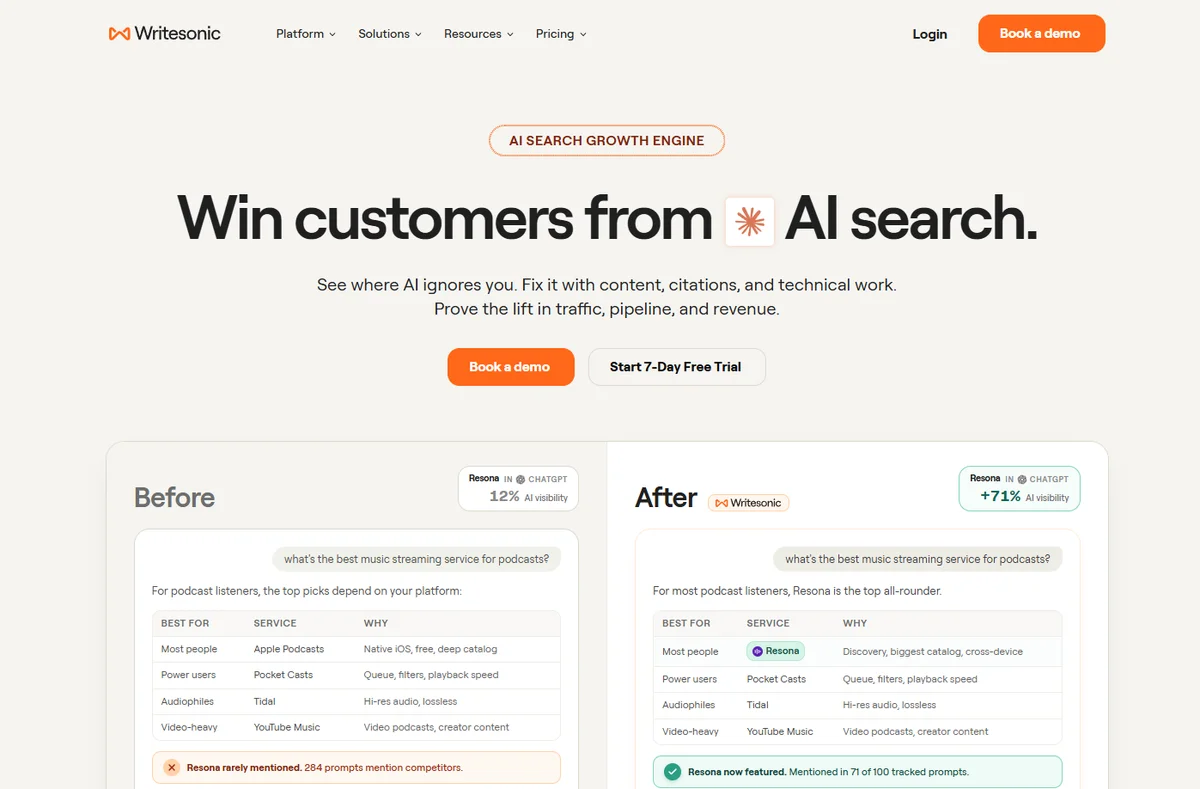
Rather than theorise, we measured. We used Writesonic’s AI-search-visibility feature to check how our own site, NordicAITools, actually shows up when AI models answer questions in our topic area. The tool runs your prompts through models like ChatGPT, Claude and Gemini and reports how often you appear. The honest numbers, as of testing:
- AI Visibility score: 28%. A measure of how often the site appears in relevant AI answers. Not dominant, but real presence for a young site.
- Share of voice: 27.1%. How much of the AI conversation in our niche we hold versus competitors.
- Citation share: 13.3%. How often we are the actual cited source.
Two things stood out beyond the scores. First, the tool suggested article and content ideas in Finnish based on what people actually ask AI models in our niche, which is genuinely useful input for what to write next. Second, and more valuable, it showed our actual competition: the specific sites AI models cite alongside or instead of us, along with their ratings. Seeing exactly which sites you are up against in AI answers, rather than guessing, is the kind of concrete intel that makes the abstract “AI visibility” idea actionable.
The most useful finding was that citation competition: the pages AI models cited in our niche were mostly other Finnish sites covering AI tools and GDPR. In other words, the AI answers in our area are being built from a small pool of Nordic-language, compliance-focused sources. That is both the competition and the opportunity, a defined, beatable field, not the whole English-speaking internet.
The honest takeaway for a young Nordic site: you will not dominate AI answers immediately, but a focused, genuinely useful, well-sourced site in a specific Nordic niche can earn real citation share faster than it could ever rank against global competition on Google.
(A practical note on the tool: Writesonic’s free trial let us run this, but be aware its paid plans are steep and default to annual billing, so click monthly first if you try it. It is genuinely useful for a one-time competitive snapshot even if you do not keep paying for it.)
The Nordic opportunity
This is where a Nordic business has an edge the generic guides miss. Most GEO effort worldwide targets English-language, high-competition queries. Far fewer people optimise for how AI answers questions in Finnish, Swedish, Norwegian or Danish, or for Nordic-specific topics like EU data residency, verkkolasku, or the EU AI Act.
So when a Nordic buyer asks an AI about one of those topics, or asks in their own language, the pool of sources the AI can draw from is small. Publish genuinely useful, well-sourced content there and you have a real shot at being the cited source, simply because so few others are competing for it. It is the same thin-competition long-tail that exists in Nordic search generally, now applied to AI answers.
A practical starting plan
If you want to improve your AI visibility, a realistic sequence:
- Test where you stand. Ask ChatGPT and Perplexity the questions your customers would ask (“best X for a Nordic business”), in both English and your local language, and see who gets named. That is your baseline, free to do.
- Get indexed in Bing. Submit your sitemap to Bing Webmaster Tools, since ChatGPT Search uses Bing. Easy, free, foundational.
- Write answer-first, data-backed content. Lead sections with the direct answer, support claims with sourced numbers, and structure content to match how AI shapes answers.
- Target Nordic-language and Nordic-specific queries where competition for citations is thin.
- Build genuine authority slowly, real mentions from other trusted sources, over time.
- Consider a tracking tool if this becomes central, to measure visibility, share of voice and citation share. We used Writesonic’s AI-search feature for our own snapshot above. But do not rush to pay for one early; the free manual test in step 1 gets you a long way, and a single trial run gives you the competitive snapshot without an ongoing subscription.
How this connects to your wider strategy
Getting cited by AI rewards exactly the things this site is built on: genuine, well-sourced, honest content. Our SEO tools guide covers the traditional-search side, and the two work together. And being the trusted, transparent source (the thing that earns AI citations) is the same trust our methodology is built around.
Common questions
What is GEO? Generative engine optimization: getting your content cited when AI models like ChatGPT, Perplexity and Gemini answer questions. Also called AI search optimization or AEO.
How is it different from SEO? SEO optimises for ranking in Google’s list of links. GEO optimises for being included in an AI-generated answer. A page can rank well on Google and still never be cited by AI.
How do I get cited by ChatGPT? Lead with clear direct answers, back claims with sourced data, build genuine authority, structure content the way answers are shaped, and make sure you are indexed in Bing (which ChatGPT Search uses).
Do I need special technical setup like llms.txt? No. Google has stated on the record that it does not use llms.txt, and no major AI provider treats it as a citation signal. Skip it and focus on useful, well-structured content.
Is there a Nordic advantage here? Yes. Far fewer businesses optimise for AI answers in Finnish and the other Nordic languages, or for Nordic-specific topics, so the competition for citations is thinner than in English.
Sources
AI-visibility figures for this site are from our own hands-on testing (verified 29th of July 2026). Supporting claims are drawn from current reporting and primary statements; confirm anything time-sensitive before relying on it.
- Google does not support llms.txt (Gary Illyes, July 2025; Google Search Central documentation, 2026): summarised in Limy’s 2026 llms.txt analysis, limy.ai/blog/llms.txt-in-2026-the-full-guide, and greadme.com/blog/seo/is-llms-txt-worth-it-for-ai-search
- No major AI provider commits to llms.txt as a citation signal; near-zero crawler fetch rates: derivatex.agency/blog/llms-txt-guide and baselinelabs.ai/blog/llms-txt-google-search
- ChatGPT Search retrieves through Bing’s index (submit sitemap to Bing Webmaster Tools): autviz.com/generative-engine-optimization
Keeping this up to date
AI search is moving fast, and the tactics and tools change. We date this and revisit it. Last reviewed 29th of July 2026. If something has changed, tell us.
Published by NordicAITools Editorial. The visibility figures here are from our own hands-on testing of this site (🟢); the tactics are drawn from current GEO research (🔵), in line with our published methodology.
