
This is general information, not legal advice. We verify everything here against official sources and date it, but if you have a specific compliance question, check with a qualified advisor or your national authority.
- The short version on The EU AI Act for Nordic Businesses
- First, are you a "provider" or a "user"?
- What actually changes on 2 August 2026 (and what just got delayed)
- The risk levels, in plain terms
- What a normal Nordic business actually needs to do
- The part Nordic businesses already care about: GDPR still applies
- Who enforces this in your country
- Where AI tools help or complicate this
- Common questions
- Keeping this up to date
The short version on The EU AI Act for Nordic Businesses
You have probably seen the headlines: a big EU AI Act deadline arrives on 2 August 2026, with real fines attached. If you run or work in a Nordic business that uses AI tools, here is the calm truth before you worry about it:
For most normal businesses, this is not the scary version. The heaviest rules fall on the companies that build AI models and on a small set of high-risk uses. If you are using mainstream tools like ChatGPT, Claude or Gemini for everyday work, what actually applies to you is short and manageable.
In one line: make sure the people using AI know what they are doing, and be honest with customers when they are dealing with AI. That is most of it. The rest of this article explains who needs to do what, in plain terms, with the detail underneath for anyone who wants it.
Update ( 4 June 2026): Since this law was written, the EU has provisionally agreed to delay the heaviest “high-risk” obligations. On 7 May 2026, EU lawmakers reached political agreement on the Digital Omnibus on AI, pushing the main high-risk deadlines back by over a year. This is good news if you fall into the high-risk category: you have more time. The detail is below, but note this delay is agreed and expected to become law, not yet formally adopted, so the picture could still shift slightly.
First, are you a “provider” or a “user”?
This is the single most important distinction in the whole law, and it decides how much applies to you.
- Provider: you build or develop an AI system or model and put it on the market. Think OpenAI, Google, Anthropic. Heavy obligations.
- Deployer (user): you use an AI system in your work. Think a marketing team using ChatGPT, a shop using an AI chatbot, an accountant using an AI tool. Much lighter obligations.
Almost every Nordic small and medium business is a user, not a provider. So if you were picturing mountains of paperwork, relax: most of that lands on the big AI companies, not on you.
The exception that raises the bar is how you use AI. If you use it for something the law treats as “high-risk” (more on that below), you take on more duties even as a user.
What actually changes on 2 August 2026 (and what just got delayed)
The AI Act is being switched on in stages. It entered into force in 2024, banned a short list of unacceptable AI uses in February 2025, and brought in rules for the big AI model makers in August 2025. The date people still talk about is 2 August 2026, when much of the rest of the law applies. But an important change happened in May 2026 that you need to know about.
The high-risk deadline has been pushed back. On 7 May 2026, the EU institutions reached political agreement on a package called the Digital Omnibus on AI. It defers the heaviest obligations, the ones for “high-risk” AI systems, well beyond the original August 2026 date:
- High-risk AI used on its own (for example AI used in recruitment or credit decisions): the deadline moves from 2 August 2026 to 2 December 2027.
- High-risk AI built into regulated products (such as medical devices or machinery): moves from 2 August 2027 to 2 August 2028.
The reason for the delay is practical: the technical standards and guidance that businesses need in order to comply were not ready in time, so the EU gave everyone more breathing room.
Important caveat: this agreement is provisional. It is expected to be formally adopted and published before 2 August 2026, but until it officially becomes law, the original dates technically still stand. In plain terms: the delay is very likely, but treat it as “agreed and coming” rather than “done.” If you are in the high-risk category, keep preparing, just with a more realistic horizon.
What still applies around August 2026. The delay is specifically about high-risk systems. The everyday rules that touch ordinary businesses, the transparency duties (being open that something is AI, labelling AI-generated content), largely stay on their original schedule. So does the basic AI literacy expectation. And the financial penalties framework still comes into effect. The one narrow exception is a short grace period for the big generative-AI providers to label their output, which was nudged to late 2026, but that is the model makers’ task, not yours.
So the honest summary: if you are a normal business using AI for everyday work, your modest duties (transparency, literacy) are unchanged. If you are in the high-risk category, you have gained over a year of extra time, pending the final adoption of the Omnibus.
Timeline for the AI ACT:
https://artificialintelligenceact.eu/implementation-timeline/
The risk levels, in plain terms
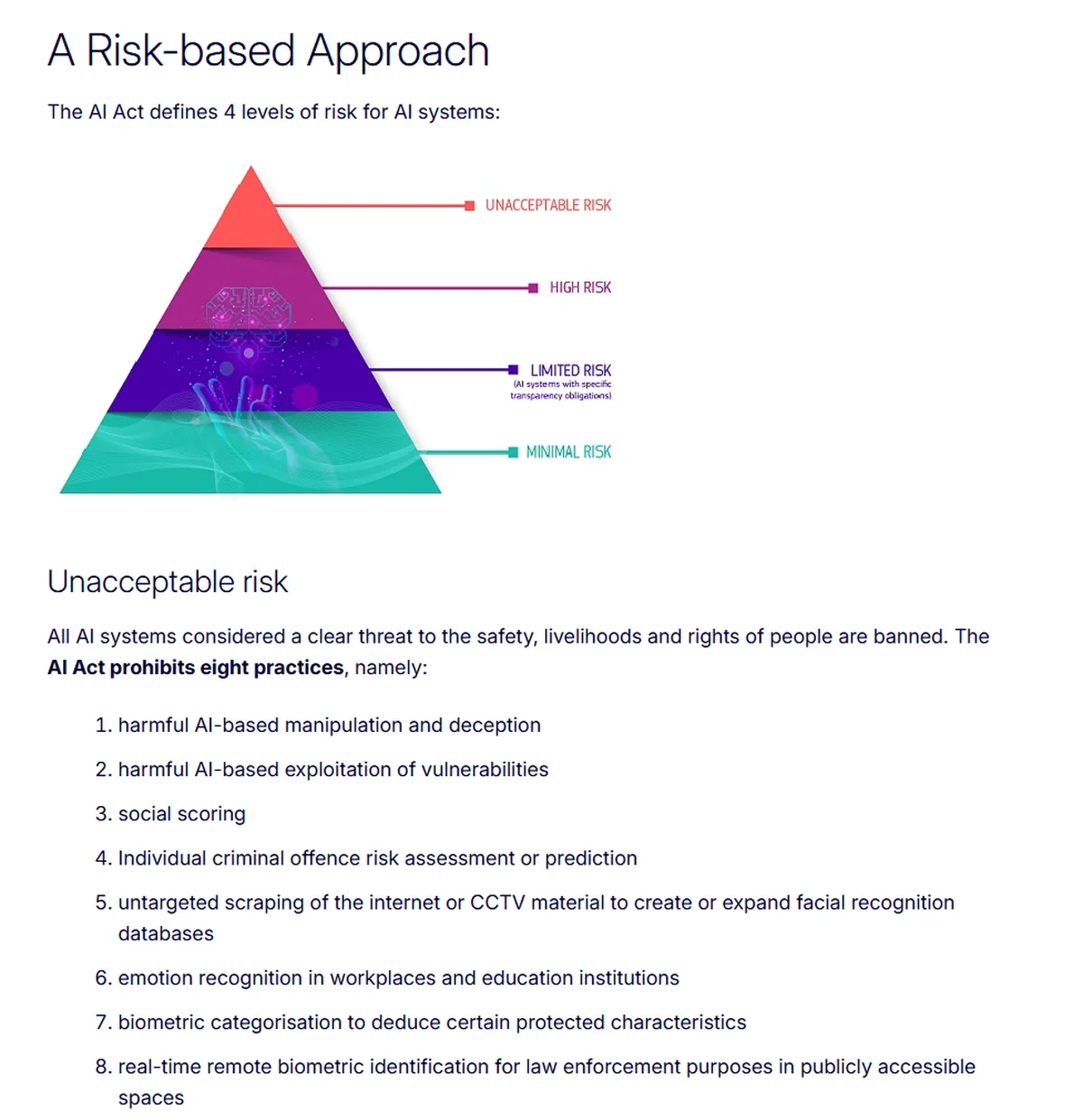
The law sorts AI uses into four buckets. Knowing which one you are in tells you how much applies:
- Unacceptable (banned): a short list of uses outlawed since February 2025, like social scoring. You are almost certainly nowhere near these.
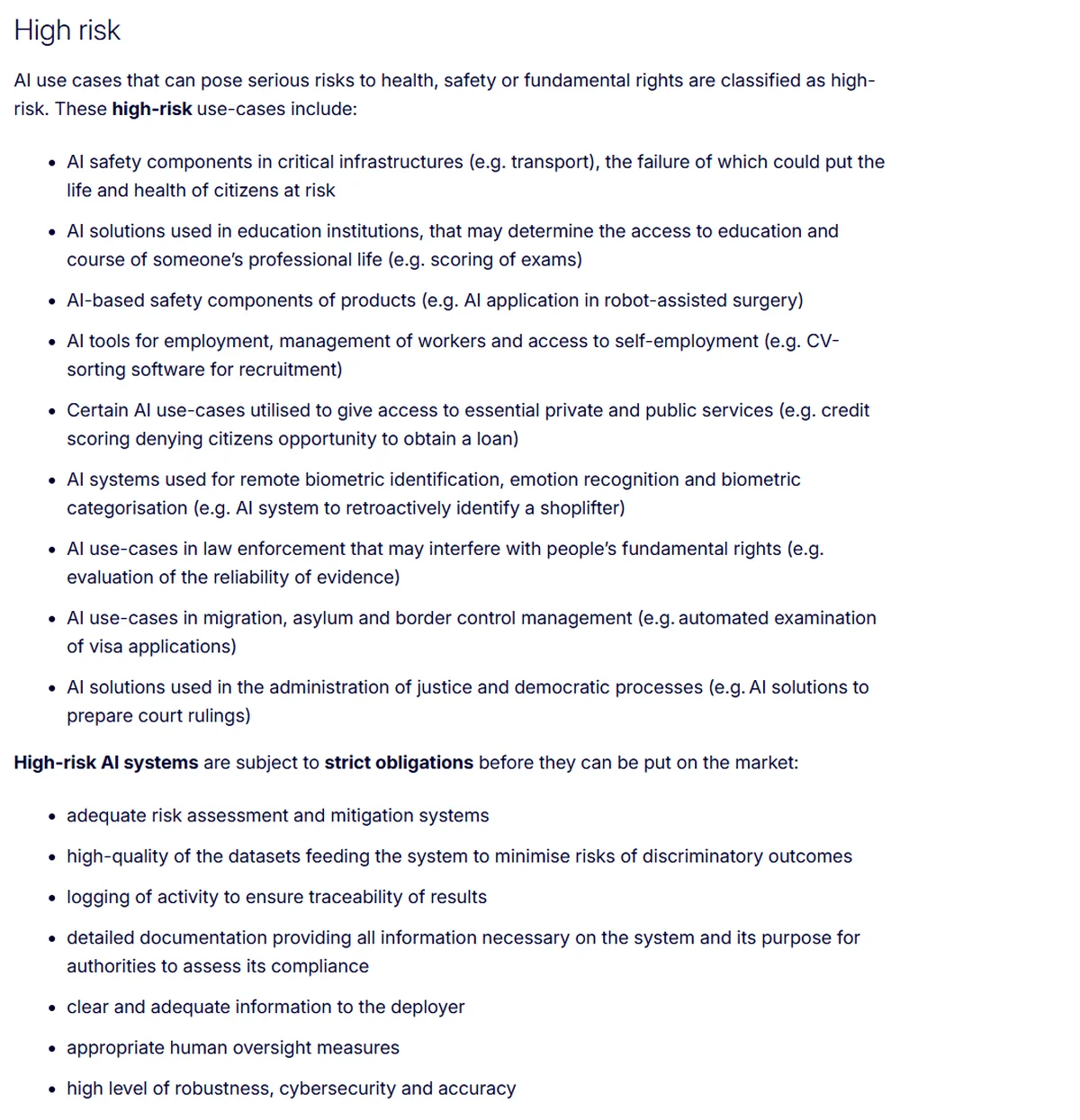
- High-risk: AI used in sensitive areas such as hiring and recruitment, credit decisions, or certain safety and biometric uses. If this is you, you have real obligations, but note the timeline has eased: the main high-risk deadline has been provisionally moved to 2 December 2027 (see the section above). You still need to prepare, just with more time than the original law gave.
- Limited risk: most everyday business AI sits here. Your main duty is transparency (be open that it is AI).
- Minimal risk: the vast majority of ordinary uses, with essentially no specific obligations beyond the basics.
So the practical question for most readers is just: am I using AI for anything in the high-risk list? If no, you are in limited or minimal risk, and transparency plus literacy covers you. If yes (for example, you screen job applicants with an AI tool), that is the part to investigate properly.
https://digital-strategy.ec.europa.eu/en/policies/regulatory-framework-ai
What a normal Nordic business actually needs to do
A short, calm checklist for a typical AI-using business:
- AI literacy. The law expects that people using AI on your behalf have a basic understanding of what it does and its limits. In practice: give your team a little training or guidance, do not let staff use AI tools blindly. This duty has actually applied since early 2025, so it is not new in August.
- Be transparent. Tell people when they are interacting with AI. Label AI-generated content where it matters. Keep it honest.
- Check for high-risk use. Run through your AI uses once. If any fall in the high-risk list (hiring, credit, biometrics, and similar), look into the extra obligations or get advice. Good news on timing: those high-risk obligations have been provisionally delayed to December 2027, so you have more runway than the original deadline suggested. Most businesses will find they have no high-risk uses at all.
- Mind the data side. If your AI use involves personal data, GDPR still fully applies on top of the AI Act. More on that next.
That is genuinely most of it for an ordinary business. No giant compliance project required.
The part Nordic businesses already care about: GDPR still applies
Here is something many summaries miss. The AI Act does not replace GDPR. Both apply at the same time to any AI system that touches personal data, which creates overlapping duties you have to handle together rather than separately.
For Nordic businesses, this is familiar territory: you are already careful about where data goes and who processes it. The AI Act adds an AI-specific layer on top of the data-protection rules you already follow. The practical upshot is that the same questions you ask about any cloud tool (where is the data stored, is there a proper data agreement, is it handled in the EU) matter just as much for AI tools.
We cover exactly where the major AI tools store data, which offer EU regions, and which provide signed data agreements, in our companion guide: AI Tools with EU Data Residency. If you only read one other thing, read that, because the data question is where AI compliance gets real for most Nordic firms.
Who enforces this in your country
This is where the Nordics differ from each other, and where a generic EU summary will not help you. Each country has named who is in charge.
| Country | Who coordinates AI Act enforcement | Note |
|---|---|---|
| Finland | Traficom (Transport and Communications Agency) as the single point of contact | Decentralised: several existing market surveillance authorities supervise within their own sectors. National supervision laws took effect 1 January 2026. |
| Sweden | Post and Telecom Authority (PTS) proposed as coordinating authority | Notably PTS, not the privacy regulator IMY, would lead. IMY still handles the data-protection side. |
| Denmark | Agency for Digital Government (Digitaliseringsstyrelsen) | Denmark was the first EU country to pass its implementing law. The Data Protection Agency and Court Administration share market-surveillance roles. |
| Norway | Norwegian Communications Authority (Nkom) | The interesting one: see below. |
Norway’s situation is worth a note, because it is not an EU member. Norway is in the EEA, so the AI Act reaches it through its own national law (the KI-loven), which incorporates the EU rules rather than applying them directly. Norway has scheduled this to take effect in summer 2026, deliberately in step with the EU, so Norwegian businesses end up on essentially the same footing and timeline as their EU neighbours. Nkom coordinates, with the data protection authority (Datatilsynet) on the data side. So if you operate in Norway, you are not exempt, you are just covered by a Norwegian law that mirrors the EU one.
Norway / Nkom: the Norwegian Government release: https://www.regjeringen.no/en/whats-new/gjor-norge-klar-for-trygg-og-innovativ-ki-bruk/id3093081/
Denmark: en.digst.dk
Sweden: pts.se
Where AI tools help or complicate this
A quick, honest note rather than a sales pitch.
Most mainstream AI assistants are increasingly building in features that help with the transparency side, like content labelling and clearer enterprise data terms. Where a tool genuinely helps your compliance is mainly in data handling (EU regions, data agreements, enterprise controls), which is the GDPR overlap above, not in the AI Act itself.
Be sceptical of any tool marketed as “AI Act compliance in a box.” For most businesses, compliance is about how you use AI and being transparent, not about buying a product. The useful tools are the ones that give you proper EU data handling and clear documentation, which we assess in the residency guide.
Common questions
Does the EU AI Act apply to my small business if I just use ChatGPT? Yes, but lightly. As a user of ordinary AI tools you are mostly in the limited or minimal risk category. Your main duties are basic AI literacy for your team and being transparent that you are using AI. No major project required.
What happens on 2 August 2026 exactly? Much of the law applies from then, including the transparency obligations, and the penalties framework takes effect. Importantly, the heaviest “high-risk” obligations have been provisionally delayed: standalone high-risk systems now have until 2 December 2027, and high-risk AI built into products until 2 August 2028, under the Digital Omnibus agreed in May 2026. That delay is expected to be formally adopted before August 2026. For ordinary businesses, the transparency and literacy duties are the relevant ones and those remain on schedule.
Are the fines really that big? The top fines are large and aimed at serious breaches like banned uses. A normal business doing ordinary things and being transparent is not the target of those numbers, but the penalties being live is why the date matters.
Does this replace GDPR? No. GDPR still fully applies. For any AI use involving personal data, you handle both together. See our EU data residency guide.
I’m in Norway, am I off the hook? No. Norway brings the same rules in through its own EEA-based law, on roughly the same summer 2026 timeline, coordinated by Nkom.
What counts as high-risk? Sensitive uses like hiring and recruitment, credit scoring, certain biometric and safety uses. If you use AI for any of these, look into the extra obligations. Most businesses do not. https://digital-strategy.ec.europa.eu/en/policies/regulatory-framework-ai
Wait, has the AI Act been delayed? Partly. In May 2026 the EU provisionally agreed the Digital Omnibus on AI, which pushes the high-risk obligations back by over a year (to December 2027 and August 2028, depending on the type). The everyday transparency and literacy duties were not delayed. The agreement is expected to become law before August 2026 but is not yet formally adopted, so we are watching it and will update this page when it is final.
Keeping this up to date
This area is moving. The Digital Omnibus on AI, provisionally agreed in May 2026, delays the high-risk obligations but still needs formal adoption, and national implementation (including the exact authority designations, Sweden’s PTS role, and Norway’s law) is still settling. We date this article and revisit it as things firm up. Last reviewed Fourth of June 2026(4.6.2026). If something has changed, tell us and we will check the official source and correct it.
Sources:
Digital Omnibus high-risk deferral (2 Dec 2027 / 2 Aug 2028), agreed 7 May 2026: European Parliament Legislative Train, https://www.europarl.europa.eu/legislative-train/package-digital-package/file-digital-omnibus-on-ai
Transparency obligations largely unchanged: confirm against the European Commission AI Act page, https://digital-strategy.ec.europa.eu/en/policies/regulatory-framework-ai
Published by NordicAITools Team, The regulatory details here are verified from official EU and national sources and dated. This is general information, not legal advice.
